How to Tell If a 12x30.5x4 Filter Is Still Working
Most homeowners pull a 12x30.5x4 out of the slot, see that it's gray, and either swap it immediately or push it back in and figure they'll deal with it next month. Both calls might be wrong.
After manufacturing air filters for over a decade and working directly with more than two million households, we've learned that 12x30.5x4 air filters tell a completely different story than their color suggests. The visual cues that work reasonably well for thin filters don't apply here. What actually reveals whether yours is working has nothing to do with how it looks from across the room.
The four checks below will tell you what the color inspection alone can't.
TL;DR Quick Answers
How do I know if my 12x30.5x4 air filter is still working?
Hold the filter up to a light source. If light passes through the pleated media, the filter still has particle-trapping capacity. Also check for weaker-than-normal airflow from vents, faster dust buildup on surfaces, and longer HVAC run cycles — all signal that the filter can no longer capture particles the way it should.
How long does a 4-inch HVAC filter last?
A 4-inch filter like the 12x30.5x4 typically lasts 6 to 12 months under standard residential conditions. Homes with pets, high occupancy, or exposure to wildfire smoke or elevated AQI should plan for replacement closer to the 6-month end of that range.
What are the signs an air filter needs to be replaced?
Dark gray or black media that blocks light, weaker airflow from supply vents, rooms that can't reach the set temperature, faster dust accumulation on surfaces, rising energy bills without another obvious cause, musty odors from the HVAC system, and worsening indoor allergy symptoms.
Can a dirty air filter still work?
A gray or partially discolored filter may still have capacity remaining, especially a 4-inch deep-media filter, which holds significantly more than a thin filter. The light-pass test is the most reliable check: if light moves through the pleats, the filter is still functioning. A completely opaque media section has reached the end of its useful service life.
Does a clogged air filter affect energy bills?
Yes. ENERGY STAR confirms that a dirty filter slows airflow and pushes the HVAC system into longer, less efficient run cycles, raising energy consumption directly. Timely filter replacement is one of the most cost-effective ways to keep HVAC efficiency where it belongs.
Top Takeaways
The 12x30.5x4 is a 4-inch deep-media filter with far more particle-trapping capacity than a standard 1-inch filter. It looks darker at the same performance level and lasts longer between replacements, which means the usual visual rules don't apply.
Four checks reveal actual filter condition: the light-pass visual test, the airflow test (white sheet method), HVAC system behavior cues, and the installation date.
Signs the filter has stopped working: the media blocks light completely, vents blow weaker-than-normal air, rooms don't reach the set temperature, dust builds up faster than usual, energy bills rise, and indoor allergy symptoms worsen.
Typical replacement interval for a 12x30.5x4 under standard residential conditions: every 6 to 12 months. Homes with pets, high occupancy, or wildfire smoke exposure should plan closer to the 6-month mark.
Write the installation date on the filter frame with a permanent marker. It's the single most effective habit for preventing filter neglect.
The .5-inch dimension makes this a non-standard size. Most home improvement stores don't stock it. Measure your actual slot before ordering.
What a 12x30.5x4 Filter Actually Does (and Why Its Size Matters)
The 12x30.5x4 is a 4-inch deep-media filter. That extra depth isn't cosmetic. More pleated surface area means the filter captures significantly more contaminant mass before restriction sets in, which is why a 4-inch filter lasts longer than a standard 1-inch filter of the same face dimensions under normal residential conditions.
At different MERV ratings, a properly working 12x30.5x4 captures:
Dust, lint, and large airborne debris (MERV 8)
Pet dander, mold spores, and fine dust (MERV 11)
Fine particles, smoke residue, and some bacteria (MERV 13)
One more thing to confirm before you test yours: the .5-inch dimension makes this a non-standard size. Most home improvement stores don't carry it. After years of manufacturing custom-dimension filters for systems that standard suppliers skip, we've seen how often homeowners discover mid-replacement that the filter on the shelf doesn't fit. Confirm your slot dimensions before ordering a replacement.
How to Tell If Your 12x30.5x4 Filter Is Still Working
Check 1: The Visual Inspection
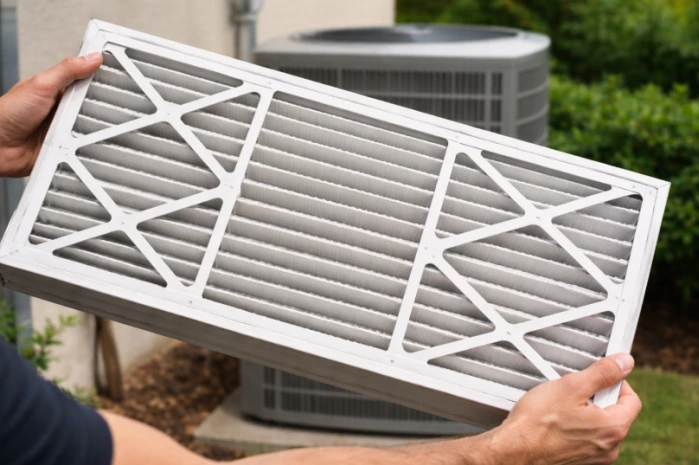
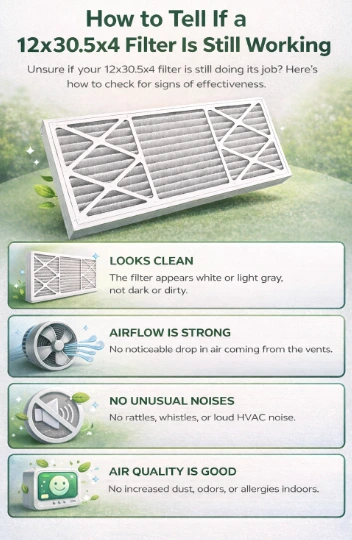
Pull the filter from its slot and hold it up to a light source. A filter with capacity remaining lets some light through the pleated media. A filter that has reached saturation blocks light completely.
Color gives you a starting point:
White or cream: new or close to it, plenty of capacity remaining
Light to medium gray: normal working condition for a 4-inch filter, still capturing particles effectively
Dark gray or black, no light passing through: the filter has reached saturation and needs to be replaced
Here's what catches most homeowners off guard. Because 4-inch media holds far more than a 1-inch filter, a 12x30.5x4 will appear darker at the same performance level. We see this constantly: homeowners who switch from thin filters to 4-inch filters pull their filter early because it looks spent. In our experience, the light-pass test is the only reliable visual indicator. Color alone isn't enough.
Check 2: The Airflow Test
Stand near a supply vent while the system is running. If airflow feels noticeably weaker than it used to, a saturated filter is the first thing to check. A clogged 12x30.5x4 creates pressure resistance in the duct system. Less conditioned air reaches your rooms as a result, and your HVAC blower works harder to compensate.
The white sheet test gives you a concrete reading:
Hang a clean white cloth or paper towel a few inches from a supply vent.
Leave it in place for five minutes with the system running.
Visible gray dust on the cloth tells you the filter is releasing particles back into circulation rather than trapping them.
Airflow loss is one of the most common complaints we hear from homeowners dealing with filter problems. It's also one of the fastest to fix. A fresh 12x30.5x4 typically restores normal airflow right away.
Check 3: System Behavior Cues
Your HVAC system tells you when it's struggling. These are the signals that point directly to a failing filter:
Rooms not reaching the temperature set on the thermostat
Longer run cycles than normal
Energy bills rising without an obvious explanation
Dust accumulating faster than usual on surfaces and furniture
Musty or stale odors coming from the vents
Worsening indoor allergy symptoms — sneezing, itchy eyes, congestion — that improve when you leave the house
Each of these points to the same problem. The filter has stopped doing its job, and your HVAC equipment and your family are absorbing the consequences.
Check 4: The Date Test
If you can't remember when you last changed the filter, that's useful information on its own.
Under normal residential conditions, a 12x30.5x4 lasts 6 to 12 months. The 4-inch media depth earns it a longer service window than a thin filter, but not an unlimited one. Several factors pull that window toward the shorter end:
Pets in the home
High occupancy or frequent visitors
Recent nearby construction or renovation
Wildfire smoke events or elevated local AQI periods
Allergy sufferers in the household who depend on consistent filtration performance
Write the installation date on the filter frame with a permanent marker. We pass this tip along to every customer who calls us about filter maintenance. It takes five seconds and removes the guesswork entirely.
"After manufacturing deep-media filters for over a decade, the pattern we see most consistently is homeowners replacing a 12x30.5x4 weeks too early — the 4-inch media holds significantly more than a thin filter, which means a darker appearance is often a sign of a filter doing exactly what it was built to do. The light-pass test is what changed how two million households think about filter maintenance, and it's the one check we'd never skip."
Essential Resources
These seven resources give you the most reliable and current guidance on filter performance, indoor air quality, and HVAC maintenance from sources you can trust.
Filterbuy 12x30.5x4 Air Filters
Filterbuy manufactures the 12x30.5x4 in MERV 8, MERV 11, and MERV 13, American-made and sized precisely to fit the systems standard suppliers skip. filterbuy.com/air-filters/12x30-5x4/
EPA — The Inside Story: A Guide to Indoor Air Quality
The EPA's guide to indoor pollutant sources, health effects, and the role filtration plays in protecting your household's air. epa.gov/indoor-air-quality-iaq/inside-story-guide-indoor-air-quality
ENERGY STAR — Heat & Cool Efficiently
ENERGY STAR's guidance on filter maintenance, replacement intervals, and the direct connection between a dirty filter and your energy consumption. energystar.gov/saveathome/heating-cooling
ENERGY STAR — How to Keep Your HVAC System Working Efficiently
Step-by-step instructions on checking, cleaning, and replacing HVAC filters before they cause costly repairs or system failure. energystar.gov/products/ask-the-experts/how-keep-your-hvac-system-working-efficiently
EPA — Introduction to Indoor Air Quality
A foundational EPA resource on indoor air pollutant sources, ventilation mechanics, and the filtration strategies that protect your home. epa.gov/indoor-air-quality-iaq/introduction-indoor-air-quality
ASHRAE — Filtration and Disinfection FAQ
ASHRAE's technical guidance on MERV ratings, filter efficiency by particle size, and what happens to rated performance when a filter loads up in the field. ashrae.org/technical-resources/filtration-and-disinfection-faq
EPA — Improving Your Indoor Environment
Practical steps the EPA recommends for homeowners who want to identify indoor air quality concerns and act on them, starting with filter replacement as a primary strategy. epa.gov/indoor-air-quality-iaq/improving-your-indoor-environment
Supporting Statistics
Americans spend approximately 90% of their time indoors — where pollutant concentrations often run 2 to 5 times higher than outdoors.
The EPA has documented this across multiple studies. For a household running a saturated air filter, those particles aren't being captured. They recirculate through every room, continuously.
Source: EPA — The Inside Story: A Guide to Indoor Air Quality epa.gov/indoor-air-quality-iaq/inside-story-guide-indoor-air-quality
A dirty air filter forces your HVAC system to work harder — and that shows up directly on your energy bill.
ENERGY STAR confirms that a clogged filter slows airflow and pushes the system into longer, less efficient run cycles. A clean 12x30.5x4 is one of the lowest-cost, highest-impact maintenance steps available to any homeowner.
Source: ENERGY STAR — Heat & Cool Efficiently energystar.gov/saveathome/heating-cooling
MERV 8 filters capture around 20% of particles in the 1 to 3 micron range. MERV 14 reaches at least 90% efficiency for the same particle size.
ASHRAE's data puts the performance gap between MERV ratings in concrete terms. A filter running past its service life delivers none of its engineered efficiency, regardless of what its original rating promised. Replacement timing is what preserves performance.
Source: ASHRAE — Filtration and Disinfection FAQ ashrae.org/file%20library/technical%20resources/covid-19/filtration-and-disinfection-faq.pdf
Final Thoughts
Fourteen-plus years of manufacturing air filters has shaped a clear view on this: the 12x30.5x4 is one of the strongest filter formats available for residential use. The 4-inch media depth gives it a longer, more consistent service window and protects HVAC equipment more effectively because it holds far more before it loads up.
That advantage disappears the moment the filter reaches saturation.
A fully loaded 12x30.5x4 becomes an obstacle in your duct system. It restricts airflow, forces the blower to strain against resistance it wasn't designed for, and releases the particles it was supposed to hold into the air your family breathes. Energy costs rise. System wear accelerates. The air quality your filter was installed to protect quietly gets worse, and the problem stays invisible until a system cue or a check like the ones above makes it visible.
Four checks: the light-pass visual test, the airflow test, HVAC system behavior, and the date on the filter frame. Together, they give you a complete and accurate picture and replace guesswork with something you can actually act on.
Frequently Asked Questions
How long does a 12x30.5x4 air filter last?
Under normal residential conditions, a 12x30.5x4 lasts 6 to 12 months. The 4-inch media depth earns it a longer window than a thin filter, but household conditions determine where in that range yours falls. Homes with pets, high occupancy, or wildfire smoke exposure should plan for replacement near the 6-month mark. Writing the installation date on the filter frame is the simplest way to stay accurate.
Can an air filter look dirty and still be working?
Yes, and this is especially true for 4-inch deep-media filters. Because the media holds significantly more than a thin filter, a 12x30.5x4 looks darker at the same performance level. Medium gray doesn't mean the filter has failed. Hold it up to a light source: if light still passes through the pleats, the filter has capacity remaining. A media section that blocks light entirely has reached saturation.
What happens if I leave a clogged 12x30.5x4 in too long?
A saturated filter creates significant airflow resistance in the duct system. The blower motor works harder, energy consumption rises, and component wear accelerates. Left long enough, restricted airflow can freeze the evaporator coil in cooling mode or overheat the heat exchanger in heating mode. Both lead to costly repairs. While the system is straining, the particles the filter was supposed to hold begin recirculating into your home's air.
Is the 12x30.5x4 a standard or custom filter size?
Non-standard. The .5-inch dimension places it outside the common stock sizes most home improvement stores carry. Filterbuy manufactures this size in MERV 8, MERV 11, and MERV 13, American-made, specifically for systems that standard suppliers overlook. Always measure your actual filter slot before ordering to confirm the fit.
Which MERV rating should I use in my 12x30.5x4 filter?
The right choice depends on your household's needs and your HVAC system's specifications. MERV 8 handles basic dust and pollen control. MERV 11 adds meaningful defense against pet dander and mold spores. MERV 13 captures fine particles, smoke residue, and some bacteria. Your system's owner manual specifies the maximum MERV rating the blower can handle. Exceed that rating and you'll restrict airflow even with a fresh, clean filter in place.
How do I know if my filter is releasing particles back into the air?
The white sheet test shows it clearly. Hang a clean cloth near a supply vent for five minutes while the system runs. Visible gray dust on the cloth tells you the filter is no longer retaining particles. Faster-than-normal dust accumulation on surfaces, gray buildup near supply vents, and worsening indoor allergy symptoms all point to the same problem.
Find Your 12x30.5x4 Filter Before the Next System Cue Beats You to It
You now know exactly how to tell if your filter is still working — and if your checks say it's time, Filterbuy manufactures the 12x30.5x4 in MERV 8, MERV 11, and MERV 13, American-made and precisely sized for the systems most retailers don't stock.
Learn more about HVAC Care from one of our HVAC solutions branches…
Filterbuy HVAC Solutions - Miami FL - Air Conditioning Service
1300 S Miami Ave Apt 4806 Miami FL 33130
(305) 306-5027
https://maps.app.goo.gl/Ci1vrL596LhvXKU79